 AU
AU
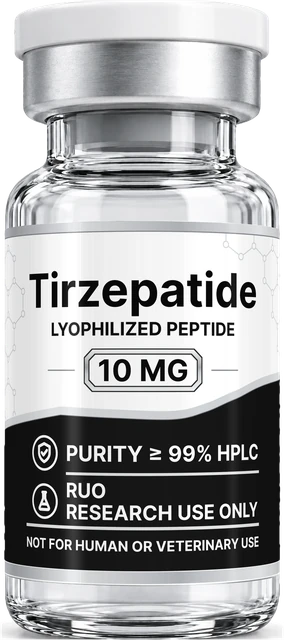
Tirzepatide has emerged as one of the most talked about compounds in metabolic research and peptide studies. The scientific curiosity surrounding tirzepatide is mostly associated with its dual receptor action including glucose-dependent insulinotropic polypeptide (GIP) and glucagon-like peptide-1 (GLP-1) pathways.
Compared to compounds that inhibit either one of the two incretin pathways, the dual GIP and GLP-1 receptors agonistic property of tirzepatide has made it relevant in studies related to glucose metabolism, insulin signalling, appetite control and more.
For scientists conducting research on the tirzepatide peptide, issues like product identity, purity and even storage are some of the factors to consider. Also in Australia, it is critical to distinguish the laboratory research compound from the TGA approved prescription medicine that contains tirzepatide.
What Is Tirzepatide?
Tirzepatide is a synthetic peptide drug that targets both the GIP and GLP-1 receptors. This drug works in metabolic pathways such as glucose-dependent insulin secretion, glucagon modulation, gastric emptying, and appetite signaling.
The dual action of the drug distinguishes it from conventional GLP-1 receptor agonists. Scientists are especially keen on the possibility of complementary metabolic effects arising from the simultaneous activation of two incretin pathways.
The drug is also the active ingredient in Mounjaro, which is a prescribed drug in Australia. While Mounjaro was initially approved by the TGA for treatment of type 2 diabetes, more indications have been approved for Australian medicines.
Why Is Tirzepatide Being Studied?
The research related to tirzepatide has mainly concentrated on metabolism. The researchers are interested in learning more about the compound because there are many biological systems that are connected to GIP and GLP-1 receptors.
Areas of interest in the research concerning tirzepatide include:
- glucose homeostasis and glycaemic regulation;
- insulin release and insulin resistance;
- appetite control and satiety signals;
- emptying of the stomach and gastrointestinal physiology;
- lipid metabolism and energy expenditure;
- body composition and adipocyte biology;
- coronary heart disease risk and metabolic risk factors.
It is especially interesting for researching the differences between the two types of receptors acting together and separately from each other.
How Does Tirzepatide Work?
The mechanism of action of Tirzepatide involves the dual stimulation of both GIP and GLP-1 receptors.
The pathways that involve GIP and GLP-1 receptors work in response to nutrients and contribute to the metabolism-related signaling.
Activation of the GLP-1 receptor is linked to glucose-induced insulin secretion, suppression of glucagon production when it is not required, slowing of gastric emptying and induction of satiety. Similarly, the signaling through GIP receptors is also involved in glucose-dependent insulin secretion.
Stimulation of both pathways provides an opportunity to study integrated actions of incretins for researchers.
Understanding Tirzepatide Dosage
The dose of Tirzepatide is context-dependent. In the case of clinical administration of a medication, there should be no confusion with experimental quantities of the substance.
In the case of Mounjaro, registered as a treatment in Australia, the consumer medicine information suggests an initial dose of 2.5 mg once weekly for four weeks, then 5 mg once weekly with the possibility of increment of 2.5 mg every four weeks or more. The maximum suggested dose is 15 mg once weekly.
The clinical directions cannot be taken as an example of an experimental procedure. Experimental concentrations depend on research goals, models, and methodology.
Tirzepatide and Research Quality
The quality of research can have an effect on the credibility and reproducibility of experimental findings. For evaluation of tirzepatide peptide for lab use, scientists need to consider much more than just the listed strength of milligrams.
Analytic information could contain high-performance liquid chromatography (HPLC) data to verify purity and mass spectrometry to validate molecular identification. An individual batch Certificate of Analysis (COA) would offer further information regarding testing and product specifications.
Scientists need to check batch traceability, package integrity, storage conditions and vendor information. Generic information on purity alone is not informative enough for scientific research.
Tirzepatide in Australia
Tirzepatide interest in Australia has grown as well, as has that surrounding incretin drugs generally. Australian scientists can research tirzepatide in fields such as endocrinology, obesity mechanisms, glucose metabolism, insulin signaling, and metabolic disorders.
The regulatory situation in Australia needs to be stated carefully. There is a prescription drug version of tirzepatide in Australia, and research laboratory versions of the compound should not be represented as being equivalent to prescription drug products. The TGA describes Mounjaro as being a prescription drug for an approved indication in Australia.
Scientists purchasing analytical material need to ensure that their institutional and regulatory requirements are met.
What to Consider Before You Buy Tirzepatide
While looking for Tirzepatide in Australia for authentic research purposes, quality should be the foremost thing to look for. The price factor alone does not prove that the product is authentic or fit for the particular research purpose.
One should check whether the vendor is providing the product details at the batch level, whether it is giving product specifications, lot numbers and proper packaging and storage conditions. In addition, one should see whether the vendor is differentiating between the research material and the registered drug.
Do not believe in exaggerated product descriptions, purity percentage or products that are claimed to be an alternative to the medicines.
Safety and Current Research
Tirzepatide is supported by a strong clinical evidence base, but safety is still an issue worth keeping track of. Known issues associated with its use in treatment include adverse gastrointestinal effects and gastric emptying delay. Safety communication has been issued by the TGA regarding GLP-1 receptor agonists and contraceptive recommendations for patients taking tirzepatide.
Laboratory material has to be treated based on lab safety guidelines, institutional guidelines and validated technical data from the manufacturer. Lab grade material is not considered to have the same manufacture, sterility or formulation standards as registered medicine.