 AU
AU
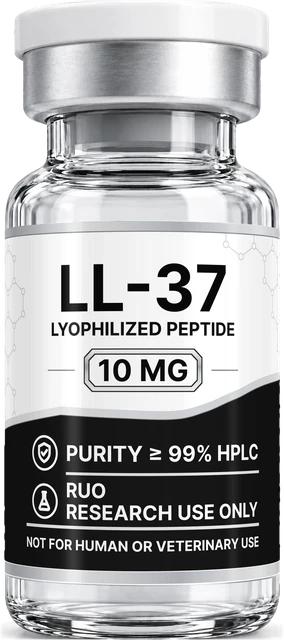
LL-37 Peptide is an antimicrobial peptide that has been studied in the fields of immunology, microbiology, inflammation, and host defense studies. This human cathelicidin-derived antimicrobial peptide is of significant scientific interest due to its possible role in innate immunity, microbial interaction, inflammation signaling, wound studies, and cellular response.
The LL-37 10 mg research preparation is designed to be used for scientific study in laboratories. The LL-37 peptide is studied in order to enhance knowledge about the activity of antimicrobial peptides, immunomodulation, membrane interaction, biofilm studies, and the complicated interaction between inflammation and host defense.
Interest in research on the LL-37 Peptide remains high among scientists who want to understand more about the activity of this peptide.
What Is LL-37?
LL-37 is a naturally occurring human antimicrobial peptide that consists of 37 amino acids. This is the product of the C-terminal fragment of the human cathelicidin antimicrobial protein, also referred to as hCAP18.
The term LL-37 originates from the presence of two N-terminal leucine residues of the peptide, symbolized as “LL,” and from the 37 amino acids contained in it. This is secreted by various cell types such as epithelial cells and immune cells and acts as part of the innate immunity system.
In laboratory research, there is more to LL-37 than antimicrobial effects. The roles that it plays in processes like chemotaxis, cytokine signaling, inflammation, angiogenesis, tissue repair model, and bacteria biofilm formation are being studied.
The synthetic LL-37 peptide facilitates the study of these biological phenomena in laboratory settings.
Why Is LL-37 Being Studied?
Study of LL-37 has been done because antimicrobial peptides are capable of executing several biological functions aside from their ability to interact with microbes. There have been studies on LL-37 which show that this peptide may play a role in many aspects of host defense and immunology.
Some of the important research areas for LL-37 are antimicrobial properties, bacterial membrane lysis, innate immunity, immune cell recruitment, inflammation signaling and biofilm formation.
Laboratory studies also study LL-37 in context with:
- Mechanisms of action and models of microbial defenses of antimicrobial peptides;
- Bacterial, fungal, viral interactions research;
- Chemotaxis and immune cell migration;
- Cytokines/chemokine signaling;
- Epithelial barrier function;
- Wound healing/tissue repair models;
- Angiogenesis/cellular migration;
- Biofilm inhibition/microbial resistance mechanisms.
All these research areas do not constitute approval for LL-37 as a treatment. Many discoveries made in laboratories have yet to be validated by clinical trials, and there may be significant differences between biological activity in cells culture and animal models and in clinical practice.
How Does LL-37 Work?
The biology of LL-37 is multi-faceted and is influenced by various factors, such as concentration, laboratory condition, the cell type used and the involvement of microbe or inflammatory stimulus.
An important topic of research is the relationship between LL-37 and the microbe membranes. LL-37 possesses a positive charge and an amphipathic nature which may help it to interact with negatively charged constituents of the microbial membrane.
It is studied whether these interactions can influence the organization and permeability of the microbial membrane under controlled laboratory conditions.
Another important topic of research is the function of LL-37 as an immunomodulatory peptide. Various experiments study the relationships in terms of immune cell recruitment, secretion of inflammatory mediators, receptor activation and cellular communication.
Various research models have examined the relationships between LL-37 and signaling networks related to cytokine, chemokine and Toll-like receptor pathways of innate immune system. However, these processes are quite complex.
Understanding LL-37 Dosage
Although there are searches conducted on the internet for the LL-37 dosage, this does not in any way translate into laboratory amounts and clinical dosing guidelines.
LL-37 10mg indicates the total amount of the research compound provided per vial. This figure does not constitute the clinical dosing amount or the procedure.
Laboratory experiments employ various concentrations in research based on the research model, test, the kind of cells used, the aim of the experiment, and other published procedures. Different experiments can have varying concentrations based on the purpose of the experiment; whether it involves testing its antimicrobial properties, effects on the membrane, signaling in cells, and inflammatory processes.
Procedures for reproducibility of LL-37 experiments in research require that all parameters be documented and that there be validated procedures. These include such things as the material used, the concentration, preparation procedure, storage, and control.
LL-37 and Research Quality
The research quality becomes especially critical while conducting experiments involving synthetic peptides. The analytical documentation allows scientists to judge the suitability of the material for a particular experimental protocol.
While evaluating LL-37 peptide for laboratory work, it is important to take into account the peptide identity, purity level, batch tracing, storage conditions and analytical documentation availability.
For the evaluation of peptide purity profile, the high-performance liquid chromatography (HPLC) is often used, and mass spectrometry can confirm the molecular identity of the peptide. Both these methods are informative but cannot be used interchangeably.
Another aspect to consider is the ability to trace the analytical documentation to a particular batch of the product. The use of general analytical documentation that cannot be traced back to a particular batch provides little traceability.
Storage is an issue to be taken into account since the stability of the peptide can be influenced by the temperature, light, humidity, and handling.
LL-37 in Australia
LL-37 Australia interest in research materials can also be seen as part of the overall increase in peptide science, antimicrobial resistance studies and immuno-biology and molecular biology.
The involvement of Australian universities, biotech companies and individual laboratories in peptide chemistry, microbe biology and immune signalling is ongoing. In this case, researchers looking for LL-37 peptide in Australia may use criteria like documentation, specification, batch number and research application for choosing suppliers.
When purchasing LL-37 10mg in Australia, laboratories will need to take into account institutional regulations and Australian regulatory regulations that apply. Research materials should always be acquired and utilized as per the scientific purpose they serve.
It is particularly vital to have detailed information about the products when choosing research peptides on the internet.
What to Consider Before You Buy LL-37
Researchers searching to buy LL-37 in Australia should evaluate more than the amount printed on a vial. Product quality, traceability and documentation can directly affect confidence in experimental work.
Consider the following factors before sourcing LL-37 peptide:
- Material identity: Check whether appropriate analytical methods support the stated peptide identity.
- Purity information: Review available HPLC data and understand what the reported result represents.
- Batch traceability: Confirm that the vial and documentation have clear batch or lot references.
- Product specifications: Check the nominal quantity, material format and intended research purpose.
- Storage information: Ensure clear storage and handling guidance is available.
- Research-use positioning: Avoid treating experimental peptide products as established medicines.
- Supplier transparency: Look for clear contact information, documentation policies and product specifications.
For scientific purchasing decisions, transparent technical information is generally more useful than exaggerated claims about potential outcomes.
Safety and Current Research
Current research related to LL-37 involves laboratory study of its properties relating to antimicrobial action, immunomodulation, inflammation, bacteria biofilm formation and response to tissue. While this peptide has shown signs of biological activity in laboratory settings, there are still many issues to be resolved regarding concentration-related activity, stability, selectivity, and applicability of preclinical results.
LL-37 may have different effects in different laboratory settings.
Handling of LL-37 10mg has to follow recommended laboratory procedures and information provided with the product. Research material cannot be advertised as pharmaceutical agent and cannot be used as such.