 AU
AU
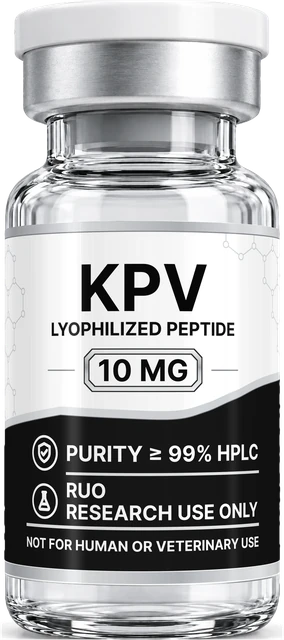
KPV peptide is an artificially created tripeptide used more frequently in laboratories to study the processes of inflammatory signalling, immunity, intestine, skin and cell communication. The name KPV represents the composition of this tripeptide that includes lysine, proline and valine amino acids and represents the C-terminal part of alpha-melanocyte stimulating hormone called α-MSH.
KPV 10mg research formula is an example of lyophilized peptide that is used during experiments in laboratories, analyses and scientific studies. The interest of scientists towards the use of KPV peptide is related to studies of inflammatory signaling pathways, cytokine activity, NF-κB signaling, intestine epithelium reaction and innate defense mechanism.
Despite of the fact that experimental data led to increased interest in KPV peptides, the existing information on this topic is mostly preclinical. KPV peptides should be assessed according to scientific and experimental data.
What Is KPV?
KPV is a tripeptide derived from melanocortins that consists of the amino acids Lys-Pro-Val. It is the C-terminal sequence of α-MSH, a naturally occurring peptide involved in melanocortin signaling and several biological functions.
KPV is not similar to other peptides that have more complex compositions. Scientists have studied the possibility of retaining of biological functions characteristic of the peptide from which it is synthesized, especially its anti-inflammatory and signaling properties.
Several studies have used KPV in experiments related to inflammation, intestines, immunity and microorganisms. Several review articles mention KPV as an important sequence of the C-terminal of α-MSH with anti-inflammatory properties investigated experimentally.
KPV 10mg is sold as a research substance for laboratory study. It is not considered as a medicine or proof of efficacy.
Why Is KPV Being Studied?
KPV research is related to its connection to the melanocortin system and its behaviour in experimental inflammatory models. Researchers want to know how short fragments of molecules may work in complicated cell processes without copying all the biological features of their parents.
The main directions of the KPV research are inflammatory signaling, cytokines production, intestine epithelium cells functioning, immune cells activity, NF-κB pathways, experimental models of skin inflammation and defense reactions.
Preclinical experiments showed that KPV worked as an anti-inflammatory agent on murine models of colitis. Also, scientists were interested in the possible work of KPV independently of the common mechanism of signaling through the melanocortin-1 receptor.
Another interesting direction of research is related to the interaction of KPV peptides and microorganisms. Scientists studied the activity of some microorganisms such as Staphylococcus aureus and Candida albicans. These studies are preclinical and cannot be considered as confirmation of KPV antimicrobial properties.
How Does KPV Work?
KPV’s exact biology is still being studied. Recent evidence points to a complex combination of several signaling pathways as opposed to a single universal pathway of action.
Inflammatory transcription signaling pathways form one area of investigation. NF-κB is an important signaling system linked to inflammation. Experiments with KPV and α-MSH-derived peptides were conducted to study the effect of peptides on NF-κB activation and translocation to the nucleus.
Other areas of interest include cytokine signaling, cell communications and reactions of the intestinal epithelium to certain environmental conditions. It is interesting for researchers to see whether KPV could affect inflammatory signaling under certain experimental conditions.
It should be noted that the interaction of KPV with melanocortin receptors represents a scientific puzzle. The problem is that although α-MSH acts through melanocortin receptors, some experiments indicate that the biological action of its small C-terminal fragments does not always depend on traditional MC1R signaling.
Understanding KPV Dosage
The dose instructions for KPV should be considered in terms of laboratory research, and not for individual use. Currently, there is no standard human dose instruction for KPV because of an approved medical use of KPV.
For scientific research purposes, the dose or concentration will vary depending on various factors, such as experimental model, methodology of the experiment, type of analysis, aim of the experiment, route of administration of the compound and analysis methodology. In cell culture experiments, the concentration-based methodology can be used, while in the animal experimentation, other methods may apply.
KPV 10 mg vial is the amount of the peptide contained in one vial. The dose is not given.
It is up to the researchers to determine the concentrations of the product using valid laboratory protocols and methodologies. Comparison of doses between the experiments will depend on the differences in models, routes and research methodologies.
KPV and Research Quality
The importance of research quality cannot be overstated in the case of KPV peptide material. Merely labelling something will not prove identity, purity, and consistency between batches.
In researching KPV 10mg, one needs to look at issues such as peptide identity, purity analysis, batch identification, storage requirements, and documentation. Some of the techniques that can be used in analysing peptides include HPLC and mass spectrometry .
HPLC can help determine chromatographic purity, while mass spectrometry can help in verifying the molecular identity. Both techniques are used for providing different kinds of information, and they are not interchangeable.
It is also important to have batch-specific documentation where the Certificate of Analysis must be linked to the specific batch/lot number so that one can analyze the documentation for the material under study.
KPV in Australia
Investigations in relation to KPV Peptide Australia indicate the scientific interest in relation to peptide science, inflammatory mechanisms, and signaling molecules. It is important to point out that there is a clear distinction between research interest in peptides and therapeutic use approval.
For products based on peptides in Australia, the regulatory status of a particular product needs to be established via official channels. According to the Therapeutic Goods Administration, products which are not part of the Australian Register of Therapeutic Goods constitute unapproved therapeutic goods which have not been evaluated by the TGA in relation to safety, efficacy or quality.
Investigators searching for KPV Peptide Australia data should make a clear distinction between laboratory materials and research data and authorized therapeutic products.
What to Consider Before You Buy KPV
Before choosing KPV peptide for research purposes, do not consider only its cost and marketing messages. Research supplies need to be evaluated using clear specification and analytical data.
Key factors are explicit indication of material amount, peptide type, batch number, availability of analytical data, storage conditions and supplier honesty. In addition, it should be checked whether the provided documentation refers to the purchased batch.
In the case of comparison of KPV 10mg research supplies in Australia, it is important not to depend only on general purity indicators. It is necessary to check the way identity and purity were estimated, the possibility of traceability of the document and clarity of the material specification.
Regulatory aspects cannot be neglected as well. Recently, TGA drew attention to the possible danger of unauthorised peptide products offered on-line.
Safety and Current Research
KPV is still an experimental research peptide. While there have been results generated through preclinical experiments that were of scientific interest, they neither indicate the safety nor efficacy of the substance for human application.
A majority of the evidence that exists consists of cell-based studies, laboratory models and animal models. The outcomes that are obtained from these models do not automatically imply that the same would happen in the case of humans. Further research is needed to know more about pharmacokinetics, metabolism, safety, dose response etc.
Any research material must be managed through appropriate laboratory protocol and Australian laws. A review of current literature is needed before planning experimental work on KPV.