 AU
AU
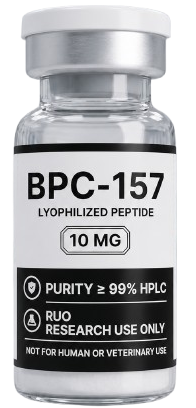
BPC-157 is a synthetic peptide investigated mainly in preclinical research involving gastrointestinal and tissue-response models. Verified Peptides supplies a nominal 10mg quantity as lyophilised research material. Review the product specifications, applicable batch report and documented storage requirements before ordering. Not for human or veterinary use.
What Is BPC-157?
BPC-157 is alternatively referred to as Body Protection Compound 157. This is a man-made compound that is made up of 15 amino acids. It has undergone laboratory studies on several biological functions such as the functioning of the digestive tract.
BPC-157 has been studied mainly in laboratories and using animal models for investigation. Scientists have looked at the possibility of its action on certain physiological processes regarding the gastrointestinal tract, connective tissues, angiogenesis, and wound healing.
The BPC-157 peptide is considered in the context of research about regenerative peptides. Nevertheless, the concept of regenerative needs to be understood cautiously. Scientific evidence does not show that this substance can be used to heal injuries or illnesses in people.
Current BPC-157 research is still experimental, and additional human trials would be required.
Why Is BPC-157 Being Studied?
Reasons for studying BPC-157 relate to the diversity of biological systems studied in experimental models.
Scientists have studied BPC-157 in the following fields:
- gastrointestinal tissue models,
- connective tissue biology,
- tendon and ligament research,
- angiogenesis and vascular signalling,
- wound-healing models,
- inflammatory signalling pathways,
- cellular migration and proliferation,
- nitric oxide pathways
One of the reasons why BPC-157 receives interest of researchers is related to the fact that the tissue repair process itself is not regulated through one single process but depends on the interaction between cellular components, extracellular matrix components, blood vessels, inflammatory signals, and growth factors.
Various biological networks involved in tissue repair have been studied experimentally in BPC-157 studies. Still, the majority of data are obtained during preclinical investigations. Findings from experimental models cannot always be directly applied to humans.
How Does BPC-157 Work?
The exact mode of action of BPC-157 has yet to be fully determined. Ongoing studies are looking at various proposed mechanisms instead of one validated mode of action.
One of the proposed modes of action that are being studied includes angiogenesis, the process wherein new blood vessels form out of existing ones. Blood vessel development is an aspect in tissue biology since tissues need oxygen and nutrients for growth and recovery.
Studies have also looked into possible connections between BPC-157 and:
- Vascular endothelial growth factor signalling
- Nitric oxide signalling
- Fibroblasts
- Migration
- Growth factors
- Extracellular matrix structure
- Inflammation
There are studies which have involved BPC-157 and its effects on tendons, muscles, and gastrointestinal tissues. There are also studies on vascular responses and cellular signalling.
The above-mentioned modes of action are still areas of study. It is essential to separate lab findings from a proven therapeutic mode of action in humans.
Understanding BPC-157 Dosage
Dosage of BPC-157 ranks among the most popularly sought after subjects regarding the peptide. There is, however, no recognised therapeutic dosage for BPC-157 in Australia.
Dosage information obtained online could be based on animal studies, laboratory protocols, conversations, or personal experiences. Such sources are not comparable to each other.
Experimental dosages in scientific research vary depending on, for instance, the following factors:
- the research design
- research purposes
- mode of administration
- duration of exposure
- dosage concentration
- animal species or cells
- endpoints measured
It is advised that researchers refer to scientific literature as well as authorised protocols in designing their experiments.
The dosage studied in an animal experiment does not automatically become a recommended dosage for human beings.
BPC-157 and Research Quality
Quality of the research material in question can affect the validity and reproducibility of the experimental results obtained. Thus, when assessing BPC-157, researchers need to take into account both analytical documentation and the product specification itself.
Among the most important qualities, one can list the following:
- certificate of analysis (COA);
- batch/lot number;
- analysis of peptide purity;
- molecular identity;
- HPLC results;
- analysis of mass spectrometry ;
- storage conditions;
- condition of packaging;
- documentation of traceability.
For determination of the chromatographic purity, high-performance liquid chromatography (HPLC) is usually employed. In turn, for molecular identity, mass spectrometry can be used due to comparing the molecular mass to the expected one.
A stated purity percentage alone does not provide a complete assessment of identity, composition, sterility or overall product quality.
BPC-157 in Australia
An interest in BPC-157 Australia studies goes hand-in-hand with overall scientific interest in experimental peptides and cell signalling pathways.
The Australian legal framework must be taken into consideration. BPC-157 cannot be regarded as an approved drug and should not be advertised as such, making false statements regarding its therapeutic effects for certain illnesses or injuries.
Scientists examining BPC-157 Australia companies must pay attention to:
- transparency of product description
- batch data
- lab analysis information
- instructions for storage and transportation
- traceability of batch
- proper research use only classification
- separation of experimental results from proved clinical effects
Also, researchers and institutions must ensure that they comply with the most recent legal requirements of the Commonwealth, states or territories for their particular use of peptides.
BPC-157 Product Documentation
Scientists trying to purchase BPC-157 peptide need to analyse product’s quality and documentation and not just promotional messages.
When choosing a BPC-157 provider you need to think of the following questions:
- Is there a batch-specific certificate of analysis?
- Can the analysis report be linked to the provided batch?
- Is HPLC or any other type of purity test mentioned?
- Is molecular identification possible?
- Are storage conditions indicated?
- Is the vial marked with a batch number?
- Does the company make unfounded therapeutic claims?
For those who study BPC-157 in Australia, regulation compliance needs to be taken into account as well. Research materials and therapeutic goods might differ by their regulations due to different purposes, formulations, claims and supply methods.
Safety and Current Research
There is emerging scientific evidence on BPC-157; however, substantial evidential gaps exist.
Many of the investigations on BPC-157 have been conducted under laboratory settings or animal models. Human data is still insufficient, while pre-clinical investigations cannot prove clinical safety and efficacy.
Quality of the product also needs to be considered in this context. Risks associated with peptides can include issues such as incorrect identity, purity, contamination, concentration, and lack of proper storage or sterilization.
Consequently, researchers should not make unfounded claims when interpreting their results.