 AU
AU
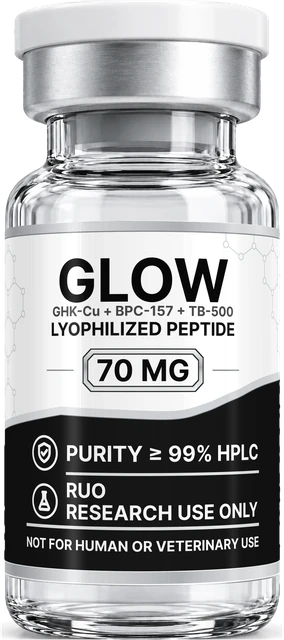
The GLOW peptide blend is an investigational formula consisting of various compounds. It has been formulated to enable researchers to study different mechanisms involved in peptide interaction as well as cellular signaling. The GLOW 70 mg formulation can be used by investigators to study complex experimental systems that involve more than one signaling mechanism.
Research interest in the GLOW peptide blend has grown in conjunction with the scientific studies being conducted on cellular migration, the activity of the extracellular matrix, fibroblasts, inflammatory signaling and the mechanisms of tissue responses. Research with a single compound would not enable scientists to study more than one peptide component in the same system.
GLOW 70 mg comes as a lyophilized research formula packaged in a laboratory vial. This product is meant for laboratory use only and should not be consumed or applied to the body.
What Is GLOW Blend?
GLOW is a peptide research mix made up of several peptides, which are intended to be tested in laboratory settings. GLOW peptide mix is a common phrase used to refer to the mixed peptide formulae involved in the study of cellular communication and extracellular matrix mechanisms.
Since the formulation of any mixture of peptides varies from one type to another, the researcher ought to check the formulation details, amounts, batch numbers, and the analysis information regarding the particular mixture being tested. The total amount of 70 mg does not provide an understanding of the concentration or the proportion of the individual components.
In laboratory research using peptides, the proportion of peptides is a very crucial variable to consider since different proportions affect receptor action and signaling activities.
Why Is GLOW Being Studied?
The study of GLOW peptides is important due to the fact that biological processes generally do not rely upon one pathway alone. The processes of cellular migration, matrix remodeling, inflammatory signaling, and tissue responses include a network of enzymes, receptors, signaling molecules, and extracellular components.
Studies could be conducted with a combination of peptides to ascertain if the combination causes different, common, or interactive responses. This may help in understanding:
- cellular migration and proliferation;
- fibroblast activity;
- organization of extracellular matrix;
- collagen research pathway;
- inflammatory mediator signaling;
- angiogenesis-related mechanisms;
- tissue response models;
- cell-to-cell signaling; and
- peptide interaction and stability.
These are the areas of experimental studies and not proven treatments. Any results obtained from experiments on cell cultures or animals cannot be generalized to humans.
How Does GLOW Peptide Blend Work?
No single mechanism of action could be used to define all GLOW blends as the biological actions of a multicomponent formulation will depend on the verified composition, ratio of its components, concentration and experiment model.
In experiments conducted in laboratory conditions, peptides might be able to act via receptors, enzymes, growth factor signaling pathways or intracellular signaling systems. When studying GLOW peptides blend, researchers could study the impact of its components on cellular migration, metabolism of extracellular matrix, fibroblast activity or inflammation signaling under certain experimental conditions.
Research using multipeptide formulations also necessitates appropriate experimental control. When multiple components are being studied together, scientists should distinguish the biological activity of each compound from the one seen in combined formulation only. The comparative models could include the untreated control, separate peptide components and research blend.
This will allow researchers to assess the peptide synergy, additive reactions and pathway interactions without the assumption that the combined formulation produces certain biological effects automatically.
Understanding GLOW Peptide Dosage
GLOW Peptide Dosage information should be considered in the light of research. The human dosage for GLOW 70mg has not been established or approved; hence, the product should not be considered as a dosage.
The amount of GLOW used in research experiments is determined depending on several considerations, such as the type of experiment, cell line used, kind of assay, period of time exposed to the substance, purpose of the research, and the amounts of the compounds.
The 70 mg label means the total amount of the substance found in the vial. This should not be considered as a dosage. Procedures should be established by qualified researchers depending on the scientific literature.
GLOW Blend and Research Quality
Quality assessment becomes especially critical when dealing with complex research materials. It should be noted that only a purity percentage is not enough to characterize a peptide mixture fully. Besides, scientists should think about the identification process, amount of components, batch tracing, documentation, and proper storage conditions.
Analytical techniques like high-performance liquid chromatography (HPLC) can be used to estimate purity and chromatographic properties of a peptide. In turn, mass spectrometry can help in identification of molecules. For a peptide mixture, the documentation should relate to the respective product and batch.
It is important to remember that reliable research materials should be provided with a batch or a lot number to ensure documentation linking to the material.
GLOW Peptide Blend in Australia
Research interest in research peptides in Australia has broadened to biochemical, cellular, and analytical research areas. In searching for GLOW peptide blend Australia, researchers need to concentrate more on clarity of material rather than unsubstantiated claims.
Key factors include product specification, process for shipping within Australia, batch number, availability of analytical reports, and proper research-use labeling. It is also necessary to bear in mind that research peptides are not necessarily medicines or cosmetics.
It is the responsibility of Australian laboratories and researchers to ensure compliance with their institutional guidelines and Australian regulations when purchasing, possessing, storing, and experimenting with the research peptides.
What to Consider Before You Buy GLOW Peptide Blend
Before choosing GLOW peptide blend for your research, review the supplier’s approach to information, traceability, and analytics. Commercial description is not an appropriate substitute for technical data.
Verify if the page on GLOW 70 mg provides the complete information about the material quantity, its form and purpose of the research. The complete composition of the blend and the component ratio should be presented in the product specification or documentation.
The batch traceability is also essential for research purposes. Researchers have to trace the batch or lot that corresponds to the vial and link available analytical data to the material.
The storage and shipping conditions are important because of the impact of temperature, moisture, light and manipulations on the peptides. While comparing GLOW peptide blends suppliers in Australia, researchers should consider documentation quality and research appropriateness along with price.
Safety and Current Research
Research on GLOW peptide blend must be performed in the right laboratories by the right people. Normal laboratory controls must be observed.
Just because there is scientific interest in a combination of peptides does not mean that the product is clinically safe and effective. Evidence related to the behavior and effects of one peptide does not mean that it is true of a combination.
GLOW 70mg is for research use only. It is not meant to be taken by anyone else for any purpose including personal use, medicinal purposes, cosmetic use or for animals.