 AU
AU
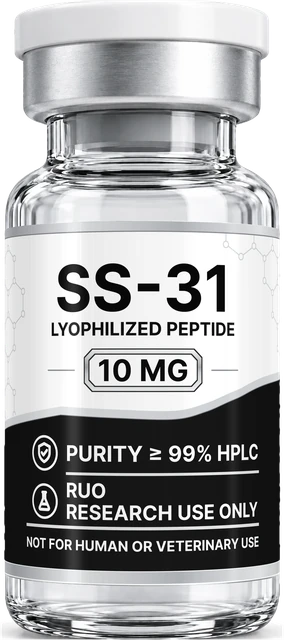
SS-31 is a mitochondria-targeted compound used in laboratory and clinical studies associated with the study of mitochondrial functioning, cellular energy production and oxidative stress. Also referred to as elamipretide and MTP-131, SS-31 has received scientific attention owing to its association with cardiolipin, a significant phospholipid found within the inner mitochondrial membrane.
SS-31 10mg research grade specifies the amount that can be used for controlled laboratory studies. Scientists interested in mitochondrial biology want to study the effects of SS-31 on mitochondrial membranes, electron transport, ATP generation and reactive oxygen species in experimental settings.
Scientific interest in SS-31 peptide research continues to increase worldwide, including in Australia where scientists study mitochondrial dysfunctions and cellular bioenergetics. Nevertheless, one should exercise care in interpreting results of scientific research as conclusions drawn from cell, animal and clinical studies are not necessarily applicable to other experimental models.
What Is SS-31?
SS-31 is an artificial tetrapeptide because it comprises four amino acid residues. It has also become popular by the name of SS-31, elamipretide or MTP-131.
SS-31 differs from many other antioxidant compounds because it has been studied due to its capacity to be targeted to the inner mitochondrial membrane. Researchers have noted that the interaction between SS-31 and cardiolipin will give clues about the organisation and bioenergetics of the mitochondria membrane.
The mitochondria play an important role in the production of cellular energy required for life. Disruption in the functioning of the mitochondria means that the ATP synthesis, oxidative state, electron transport and cellular signalling will also change.
Why Is SS-31 Being Studied?
SS-31 is under investigation as mitochondrial dysfunction is linked to many biological and medical issues. Various scientific experiments have been performed for elamipretide in terms of its relevance to skeletal muscle, cardiovascular system, renal function, neurology, and mitochondrial diseases.
Key topics of SS-31 peptide research are:
- mitochondrial membrane integrity and cardiolipin;
- cellular metabolism and production of ATP;
- oxidative stress and reactive oxygen species;
- electron transport chain;
- mitochondrial cristae morphology;
- study of muscles and exercise physiology;
- cardiovascular and renal experiments;
- age-related mitochondrial alterations.
This list of research topics does not prove that SS-31 is a universal therapy or health product. The importance of results from experiments depends on the experiment itself, type of experimental model used, dosage and duration of the experiment and parameters measured.
How Does SS-31 Work?
SS-31 operates through a mitochondrial/cardiolipin pathway.
Cardiolipin is a specific phospholipid found mainly in the inner mitochondrial membrane. It helps to form the structure of the membrane and to perform proteins responsible for oxidative phosphorylation.
Scientists have observed SS-31 interactions with cardiolipin and effects on mitochondrial membrane organization. This interaction was researched in respect to cristae formation, functioning of the respiratory chain, oxidative stress and ATP synthesis.
In other words, it is being studied how SS-31 can help mitochondria to operate more efficiently in certain experimental circumstances. According to scientific literature, SS-31 was linked to the stability of mitochondrial membranes, to lower oxidative stress and better energy generation in some experiments.
A reaction to this molecule may differ greatly depending on the organism used.
Understanding SS-31 Dosage
SS-31 Dosage may mean different things in different settings. “A 10mg vial” is the total volume of the study material contained in the vial; however, it does not establish a standardized dosage or the protocol.
The following elements can influence the concentration and exposure of substances used in scientific studies, including:
- The nature of the experiment and its objectives;
- In vitro or in vivo experiment techniques;
- Biological or other models;
- The route and schedule of the exposure in the experiment;
- The duration of the experiment itself;
- Scientific procedure.
Experimental concentrations should be calculated using the appropriate methodologies and standards and should not be suggested as a personal dosage.
SS-31 and Research Quality
Quality of research is very critical particularly where specialised peptides are involved. The purity percentage alone does not tell the whole story regarding material quality.
Scientists assessing SS-31 peptide need to take into account identity testing, purity assessment, traceability of batches, documentation and proper storage. Techniques for purity and identity testing include high-performance liquid chromatography and mass spectrometry .
High quality research materials must also be traceable and well documented, being associated with particular material. Good handling is critical since different storage conditions, light, temperature changes and freeze-thaw cycles may affect the stability of the peptide.
SS-31 in Australia
Searches for SS-31 Australia may indicate increasing interest in mitochondrial peptides and biochemistry studies. Laboratories and scientists in Australia looking into SS-31 should differentiate between research substances and therapeutic supplies of SS-31 that are approved.
The regulation status, import rules, and permissible applications may be modified from time to time. Scientists and organizations in Australia should verify any applicable rules before acquisition, importation, supply and application of research peptides.
Australian scientists researching SS-31 peptide suppliers could pay more attention to documents, batch identification, analysis details, shipment details, and specifications of a peptide rather than marketing statements.
What to Consider Before You Buy SS-31
For researchers looking to purchase SS-31 in Australia, there are issues of product quality and documentation that must be considered. Price will give you little indication of whether the product is a genuine peptide.
Before deciding to purchase SS-31 10mg for use in laboratory-based research, think about how well the supplier handles issues relating to analytical testing, batch tracking, labelling, storage and research information.
A legitimate research material is one that can be clearly identified and documented. Researchers must also look at whether the analytical reports available correlate with the batch being sold.
Do not take any statements at face value that may imply guaranteed anti-ageing, performance, energy or disease treatment. Research into SS-31 is highly specialized and scientific and should be evaluated accordingly.
Safety and Current Research
The progress of SS-31 has been made past the level of laboratory studies and has reached the level of human clinical trials. Studies on the use of elamipretide have been conducted in the context of mitochondria as well as other diseases, but lab studies are continuing on how it impacts cardiolipin, oxidative phosphorylation, mitochondria, and energy metabolism.
It must be noted that clinical trials do not mean that all products of SS-31 available on the web are suitable for private use because the research grade products and medicines belong to different categories and are not equivalent.
Current findings must be analyzed based on research participants, outcomes, time frame and methodology of research.