 AU
AU
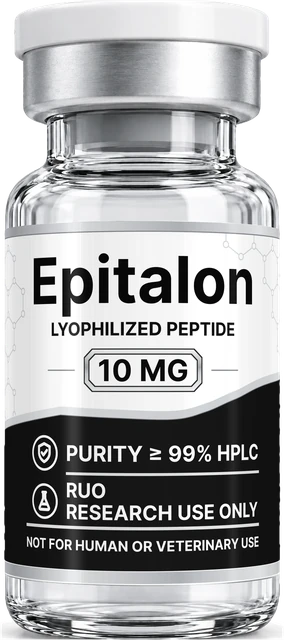
Epitalon is a synthetic tetrapeptide used in studies of ageing science, telomere biology, cell signaling, and pineal gland physiology. Synonyms for this compound are Epithalon, Epithalone, and AEDG peptide – a name which stands for Ala-Glu-Asp-Gly (a tetrapeptide consisting of four amino acids).
Scientific interest in Epitalon research is primarily related to studying its effects on the activity of telomerase, length of telomeres, cellular aging processes, gene expression, oxidative stress and biological rhythms regulation. In addition, laboratory and preclinical studies have examined the relation between Epitalon and pineal gland physiology, melatonin signaling, and cellular differentiation.
It should be noted that Epitalon is currently still in the experimental research stage. The current evidence base includes in vitro research, animal experiments, and some human research.
What Is Epitalon?
Epitalon is a simple artificial peptide containing alanine, glutamic acid, aspartic acid, and glycine. The sequence of its amino acids can be abbreviated to AEDG.
Epitalon peptide was created on the basis of studies related to the Epithalamin, which is a natural biological extract from the pineal gland containing peptides. As compared with the complex structure of biological extract that has many components, artificial Epitalon has a defined four-amino-acid sequence for scientific investigation.
Epitalon peptide is relatively simple and because of this, this substance has become a research topic in the following fields:
- telomeres and telomerase research;
- cellular senescence and aging models;
- gene expression and epigenetic regulation;
- oxidative stress and antioxidant defence;
- pineal gland physiology;
- circadian rhythm and melatonin research;
- cellular proliferation and differentiation.
According to the scientific review in 2025, Epitalon is described as Ala-Glu-Asp-Gly tetrapeptide and summarizes more than twenty years of scientific investigations in vitro, in vivo and in silico in order to study its biological activities.
Why Is Epitalon Being Studied?
Studies on Epitalon have been conducted due to their biological activity demonstrated in several experimental models. The most common one is the studies on the link between Epitalon, telomerase and telomere length.
The telomere is a DNA-protein complex located at the ends of chromosomes and protecting their integrity. But telomere shortening may occur during cell division. For that reason, telomere biology has become a highly important part of the field of cellular aging studies.
According to one study conducted in the laboratory, Epithalon application resulted in telomerase activation and telomere elongation in human somatic cells in vitro. The results of this study greatly increased the interest in Epitalon research. But cell culture experiments cannot be regarded as a proof of longevity-extending effects of Epitalon in humans.
Also, the fields of gene regulation, neuron differentiation, pineal physiology, and biological aging are under study. Experimental studies have considered the interaction of the AEDG peptide with gene expression process.
How Does Epitalon Work?
Epitalon’s mechanism is not fully understood. It appears that Epitalon may affect multiple biological mechanisms in the body rather than relying on just one fully studied receptor mechanism.
Telomerase and Telomere Research
One of the suggested mechanisms includes telomerase, an enzyme complex responsible for regulation of telomere lengths. Studies have been conducted in order to find out how Epitalon affects telomerase pathways and telomeres in certain types of cells.
Modern studies include studies with human cell lines and analysis of telomere lengths regulated by telomerase upregulation.
Gene Expression and Cellular Signalling
Interactions between epitalon and chromatin, histones, and the process of gene expression have also been studied. The role of AEDG in regulation and cellular differentiation has been explored through experimental studies, but further study is needed.
Pineal and Circadian Research
Since Epitalon studies have arisen through the study of peptides in the pineal gland, the molecule is also used in research concerning the pineal gland, biological rhythms, and melatonin signaling.
These research topics have led to interest in Epitalon as a laboratory chemical for understanding the connection between aging, endocrinology, and circadian regulation.
Understanding Epitalon Dosage
Epitalon dosage searches are very popular, but dosage information needs to be interpreted carefully.
There is no generally accepted dosage of Epitalon therapy for humans. The dosage of Epitalon used in experiments depends on whether in vitro or animal testing is performed.
For experimental research, experimental concentration should be derived according to the experiment protocol and the published methodology. This may involve the following variables:
- type of cell or biological system;
- objective of the experiment;
- peptide concentration;
- duration of exposure;
- solvent and preparation;
- conditions of storage;
- sensitivity and endpoint detection.
It is incorrect to transfer experimental concentrations between different systems automatically.
Epitalon and Research Quality
Quality is an especially significant issue when dealing with peptides created in the lab. Simply labeling the peptides with a name and quantity is insufficient proof of their authenticity and purity.
Analytical data and information about Epitalon peptides could include:
HPLC analysis: High-performance liquid chromatography could be used to test for purity and impurities.
Mass spectrometry: Testing by mass spectrometry
Batch information: It is necessary that each research vial contain information about its batch/lot number. Certificate of Analysis: The available analytical data should be batch-specific rather than being provided in a general product information form. Storage information: Because peptides are sensitive to water, heat, light and manipulation, storage conditions should be documented. Quality of research material should be evaluated based on multiple pieces of information rather than one purity percentage. Interest in Epitalon Australia studies has increased along with general scientific interest in longevity science, peptide signaling, telomere science, and cell aging. Researchers studying Epitalon peptide product in Australia need to separate clearly their laboratory research product from any product that may be represented with therapeutic claims. The regulatory requirements may vary depending on how the product is used, claimed, presented, imported, and other factors. The Therapeutic Goods Administration (TGA) in Australia regulates therapeutic products and has enforced law in regard to the illegal importation of unapproved peptide products. The TGA should be well understood by researchers, importers, and suppliers of peptide products before importing, supplying, or making therapeutic claims regarding peptide products. Epitalon research products should be considered according to their purposes and other relevant criteria. For the purpose of determining the best place to purchase Epitalon in Australia for genuine research purposes, considerations such as pricing alone cannot be made. It is important that researchers consider the presence of product specifications, batch number clarity, analysis documentation and proper storage guidelines by the manufacturer. The product name, quantity and batch number must match in the vial label, product website and certificate of analysis where relevant. Among the considerations that should be evaluated are: the name of the peptide, test methods used, purity information, batch traceability, packaging, storage and transparency of the supplier. Scientists should also avoid being lured into exaggerated claims. Words such as anti-aging peptide and longevity peptide have been frequently used to refer to Epitalon online but these may be misleading. However, the safety data on Epitalon is not entirely known, since there is a lack of large and independently reproduced studies in terms of long-term clinical trials. Even though some interesting findings have been obtained through laboratory and preclinical studies, there are many questions left concerning long-term effects, dose response, tissue specificity, pharmacokinetics, and clinical significance. In general, one should approach the existing knowledge about Epitalon with caution. It is scientifically interesting to study, especially when speaking about telomere biology and cellular aging, but the findings from experiments cannot be regarded as evidence.Epitalon in Australia
What to Consider Before You Buy Epitalon
Safety and Current Research