 AU
AU
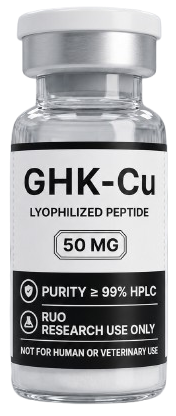
GHK-Cu is a copper-binding tripeptide complex investigated in extracellular-matrix and cellular-signalling research. Verified Peptides offers lyophilised GHK-Cu in 50mg and 100mg quantities. Compare the available options and review the applicable specifications and batch documentation before ordering. These materials are supplied for laboratory research only.
What Is GHK-Cu?
GHK-Cu is a natural copper compound that is produced through the interaction between the tripeptide glycyl-L-histidyl-L-lysine, known as GHK, and a copper ion.
The tripeptide has been found in human plasma and further studied in various biological liquids. The high binding capacity of GHK-Cu to copper plays a major role in scientific investigation since copper is related to multiple enzyme systems and biological processes.
Research involving GHK-Cu is usually associated with:
- extracellular matrix remodelling;
- studies of collagen and elastin;
- fibroblast activity;
- migration and signaling of cells;
- models of wound healing;
- antioxidant defense systems;
- inflammatory signaling;
- angiogenesis studies;
- gene expression studies; and
- dermatology and hair biology.
GHK-Cu should not be confused with regular copper supplements since it is a specific combination of a copper ion and a peptide which is the subject of scientific investigation.
Why Is GHK-Cu Being Studied?
Scientific interest in GHK-Cu peptide arises due to the possible involvement of the compound in biological signaling and copper transport.
The first research field is concerned with the biology of extracellular matrix. Studies in laboratory settings have looked at the interaction of GHK-Cu with structural proteins such as collagen and elastin. Scientists are interested in studying the role of peptide-mediated signaling in the functioning of fibroblasts and matrix metabolism and remodeling processes.
Tissue regeneration is another research topic for GHK-Cu. Studies in laboratory settings have been conducted on cellular migration, angiogenesis, inflammation and tissue remodeling in connection with the peptide.
The skin biology is another field of research for GHK-Cu. Research models have been used to investigate collagen metabolism, glycosaminoglycans, dermis structure and cellular reactions in connection with tissue aging.
Hair follicle research, oxidative stress, inflammation pathways and gene expression have also attracted scientific interest regarding GHK-Cu. However, research outcomes depend on the research model, dosage, formulation and design of study.
How Does GHK-Cu Work?
It is considered that the biological effects of GHK-Cu are produced by means of several interrelated mechanisms but not by one way only.
GHK peptide has the capacity to bind copper ions and can be involved in copper transportation and delivery process. Copper ions are cofactors of many enzymes necessary for biochemical processes, such as connective tissue biology, antioxidant defense and others.
There are several possible mechanisms of the action of GHK-Cu which were investigated by researchers:
Binding and transportation of copper ions: GHK binds copper ions forming a stable complex named GHK-Cu which is studied in the field of biochemical science.
Signalling in the extracellular matrix: The laboratory researches include its relation with collagen, elastin, proteoglycans and other elements of extracellular matrix.
Signalling in fibroblasts: Fibroblasts are responsible for the production and maintenance of the extracellular matrix components; GHK-Cu researches often study the signalling of these cells.
Pathways of oxidative stress: Experimental research includes the interaction of GHK-Cu with the pathways of oxidative damage and defense of organism.
Influence on gene expression: Some researches have been done in the field of gene expression in relation with GHK-Cu.
Understanding GHK-Cu Dosage
GHK-Cu dosage is frequently searched for online, however, it is necessary to distinguish between quantities used in laboratory experiments and medical doses.
GHK-Cu 50mg and GHK-Cu 100mg refer to the amount of the research material provided in one vial or product combination. These values do not indicate a medical dose or therapy regimen for humans.
Experimental concentration of GHK-Cu in laboratory studies may vary depending on:
- a particular research model;
- type of cells/tissue systems under study;
- research goal;
- experimental technique;
- method of experimental administration;
- choice of solvent; and
- duration of exposure.
When conducting an experiment with GHK-Cu researchers have to follow the validated protocol, scientific methodology and institutional procedures.
GHK-Cu 50mg and GHK-Cu 100mg could fit various experimental protocols, however, the choice should be made based on a particular research protocol.
GHK-Cu and Research Quality
Product quality assessment is a factor that should be considered during peptide research. Only purity percentage does not give an accurate understanding of research material quality.
During evaluation of GHK-Cu peptide for laboratory study, the following factors may be considered by researchers:
Identification testing: Mass spectrometry or any other technique might assist in confirming the molecular identification.
Purity determination: High performance liquid chromatography (HPLC) is one of the common techniques for the determination of purity of the substance.
Traceability: Batch or lot number identification would assist in linking the product with its analytical data.
Certificate of Analysis: The available certificate of analysis should match the particular batch and provide analytical information.
Storage: Peptides can be influenced by temperature, humidity, light and multiple manipulations.
Documentation: The product specifications should include the information on the name of the substance, its quantity and proper storage conditions.
Australian researchers considering the purchase of GHK-Cu 50 mg or GHK-Cu 100 mg may benefit from clear information and documentation of the batches.
GHK-Cu in Australia
Research into GHK-Cu Australia has grown along with the general scientific interest in peptides, copper binding substances, regenerative sciences and skin science.
When Australian labs or researchers assess GHK-Cu peptide for research purposes, they need to take account of their planned research usage, documentation, batch numbers and storage needs. The product description must make clear whether the materials are for research purposes only and not approved medicinal items.
Peptides may have differing regulatory statuses depending upon the peptide, its use, claims, distribution route and other factors. Research institutes and companies need to be aware of current requirements concerning their situation before importing, distributing, possessing or using research materials.
GHK-Cu research products should be accurately represented and not marketed as replacements for medicines or professional medical advice.
Comparing GHK-Cu 50mg and 100mg
GHK-Cu peptide Australia research should involve factors other than just product quantity or cost.
Such considerations may include identification of the compound, analysis, traceability of batches, technical characteristics of the product, storage and availability of related documentation. For the comparison of GHK-Cu 50mg vs. GHK-Cu 100mg, it is necessary to choose quantities based on the protocol required for an experiment.
Prior to purchasing of research products, it is worth considering whether the provider can offer the following information: batch identification, availability of COA, package details and realistic description of the product from a research point of view.
Marketing statements about the guarantee of cosmetic, anti-ageing, hair growing and therapeutic effects should be viewed skeptically since results of experiments do not prove anything regarding approval or effectiveness for a certain use.
Safety and Current Research
The topic of GHK-Cu is currently under laboratory and experimental study. Topics of interest include extracellular matrix remodeling, collagen synthesis, cell signaling, oxidative stress, inflammation mechanisms, wound healing, and skin physiology.
Even though GHK occurs naturally, this does not imply that all preparations, dosages, or exposures to GHK-Cu have proven safe for individual use. Contamination and the preparation process may influence research results.
It is imperative for researchers to apply proper controls and procedures while undertaking their studies. Scientists must ensure they utilize contemporary scientific literature.
The supplied research material is not intended for human or veterinary use. Findings from published studies should be interpreted within the limitations of the material, formulation and experimental model investigated.