 AU
AU
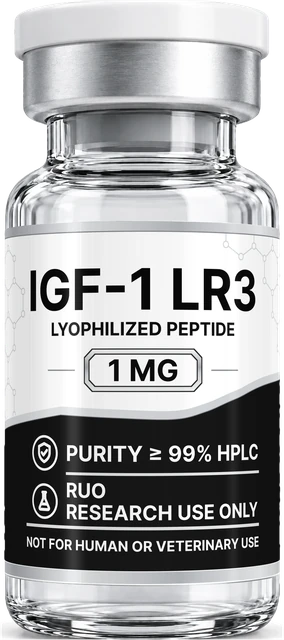
IGF-1 LR3 Peptide is a modified form of insulin-like growth factor 1 used in lab investigations for its involvement with IGF-1 receptor signaling mechanisms, cell proliferation studies, and metabolism model systems. The IGF-1 LR3 1mg research vial is formulated as lyophilized peptide substance for laboratory investigation only.
What Is IGF-1 LR3?
Long R3 IGF-1 is another name for the IGF-1 LR3. The compound has structural differences from the native insulin-like growth factor 1 because it has a longer amino acid chain and an altered arginine. The changes are researched since they can affect the binding, stability, and interactions with IGF-binding proteins.
Regarding the study of peptides, Long R3 IGF-1 is usually studied in connection with the IGF-1 receptor activation, cell proliferation, protein synthesis, glucose uptake mechanisms, and growth factor signaling. It is neither drug, dietary supplement nor cosmetic.
Why Is IGF-1 LR3 Being Studied?
IGF-1 LR3 is investigated due to the fact that the IGF-1 signalling pathway has a key role in cellular communication, tissue formation, metabolism and growth factors. Investigators can use IGF-1 LR3 as a model to see how IGF analogues react differently from the natural IGF-1.
The scientific investigation may include: the receptor binding, cell survival pathways, muscle cell model, fibroblast function, cartilage investigation, metabolism, amino acids transportation and cell differentiation. All of the above-mentioned areas are experimental and must not be described as therapeutic effects.
How Does IGF-1 LR3 Work?
The interaction of IGF-1 LR3 with the IGF-1 receptor is usually considered when studying IGF-1 LR3. The activation of the pathway could affect other pathways, such as PI3K/Akt and MAPK pathways, that are usually under investigation in studies on cell growth, survival, and metabolism.
Since IGF-1 LR3 has lower affinity for IGF-binding proteins than natural IGF-1, scientists study whether it affects experimental properties of IGF-1 LR3.
Understanding IGF-1 LR3 Dosage
Discussion on IGF-1 LR3 dosage is only relevant within laboratory research. An IGF-1 LR3 dosage is not prescribed for human use at present. This item should never be used for self-medicating, body building, athletic purposes or for veterinary purposes.
One milligram of vial refers to the total amount of peptides provided. The research concentration will depend on the nature of experiment, assay used, exposure time, solvents used and cell culture type.
IGF-1 LR3 and Research Quality
Quality is an important issue for the studies involving growth factor mimics like IGF-1 LR3. The researchers need to analyze the factors like peptide identity, purity, batch, analysis report, Certificate of Analysis, HPLC results, mass spectroscopy data and storage information.
Reproducibility of studies using peptides requires each vial to have batch information. The storage, manipulation and reconstitution of the vial are other variables that need control.
IGF-1 LR3 in Australia
There has been growing interest in IGF-1 LR3 peptide Australia from researchers doing research on growth-factor signalling pathways and metabolic peptide research. Researchers in Australia should concentrate on research materials that comply with regulations with clear specifications.
IGF-1 LR3 1mg is for research purposes only. It cannot be used for human consumption, injection, therapy, cosmetics, or veterinary use in Australia.
What to Consider Before You Buy IGF-1 LR3
Prior to purchasing IGF-1 LR3 for research in Australia, it is essential to ensure that your supplier can offer you clear specifications about the product.
Critical aspects to examine here are whether the product is indeed a peptide, its quantity, purity details, COA provision, storage, shipping conditions, as well as whether there are any medical or performance claims on the website.
Concerning IGF-1 LR3 1mg, it is essential to examine whether the product will be applicable for your chosen model, as well as whether the concentration is appropriate after dilution.
Safety and Current Research
IGF-1 LR3 is to be used strictly under controlled lab conditions and only by trained professionals. It should be used solely for experimental purposes in research and not be applied anywhere else.
Present-day investigations of IGF-1 LR3 are conducted through experimental signaling pathways and growth factors. Results from studies with cells or animals cannot be considered as evidence of its safety and efficacy in humans.