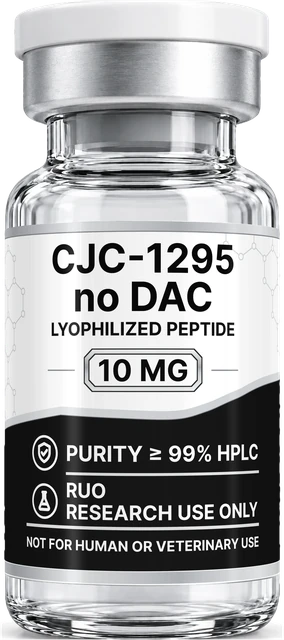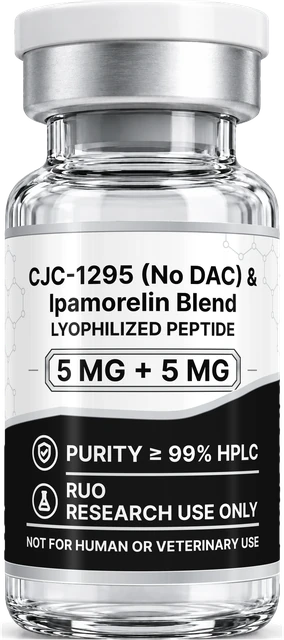
 AU
AU
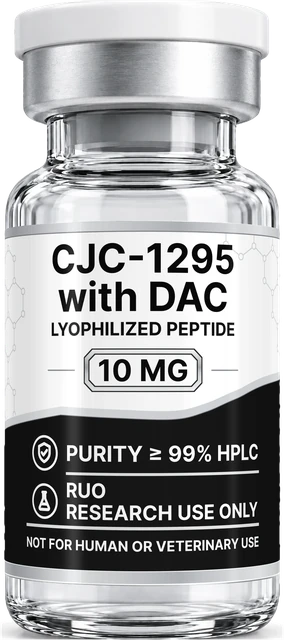
CJC-1295 with DAC is a synthetic peptide under investigation in connection with growth hormone releasing hormone (GHRH), endocrine signal transduction systems and GH/IGF-1 axis studies.
The development of CJC-1295 with DAC was carried out to address the issue of the very low biological activity of natural GHRH by employing Drug Affinity Complex technology, also known as DAC.
CJC-1295 with DAC 10mg is a lyophilised peptide research formula created for experimental studies. Scientific interest in the compound is related to its extended pharmacokinetics, protein binding abilities, pituitary signaling and effect on GH and IGF-1 research models.
Human clinical trials of early years characterized CJC-1295 as a long-acting analog of GHRH and studied its pharmacokinetics/pharmacodynamics and GH/IGF-1 concentrations.
What Is CJC-1295 with DAC?
CJC-1295 with DAC is a synthetic variant of growth hormone releasing hormone. GHRH plays a role in the hypothalamic-pituitary signaling process where it acts as a regulator of endogenous growth hormone secretion.
The distinguishing characteristic of the DAC variant is that of increased biological activity. The Drug Affinity Complex was created specifically for interaction with circulating albumin, providing the peptide with an extended period of action in contrast to the short acting GHRH derivatives.
According to preclinical studies, CJC-1295 is a synthetic human GHRH analog which is able to bind to endogenous albumin.
This is an important detail regarding peptide studies, since CJC-1295 with DAC is studied as a long-acting drug, while the variants that are referred to as CJC-1295 without DAC have shorter duration of action.
Why Is CJC-1295 with DAC Being Studied?
The majority of scientific papers devoted to CJC-1295 peptide investigation are related to endocrinology and GH/IGF-1 axis regulation. The researchers have chosen this compound to investigate long-term GHRH receptor signalling since long-lasting GHRH receptor activation gives the opportunity to study long-term signalling processes instead of short peptide application.
Main directions of investigations are the following:
- GHRH receptor signalling
- pituitary growth hormone release
- GH pulses features and baseline GH release
- IGF-1 production and signal transduction
- peptide pharmacokinetics and prolongation of half-life time
- albumin-binding technology
- endocrine feedback mechanisms
- peptide long-term application
It was shown in scientific literature that CJC-1295 increased mean and minimum GH release and serum IGF-1 levels without changing GH pulsatility in investigated conditions. This fact contributes to further scientific interest to prolonged GHRH signalling.
How Does CJC-1295 with DAC Work?
Interaction between CJC-1295 with DAC and GHRH receptor as well as prolonged biological exposure from albumin binding are explored.
The research design starts off by activation of the GHRH receptor on the pituitary somatotroph cell. The signal will lead to the release of endogenous growth hormone. In turn, GH can cause hepatic and peripheral signals for the production of IGF-1.
The DAC is pivotal to the research aspects of the compound. As a result of increased persistence in circulation, researchers can study prolonged receptor stimulation and endocrine response.
In human research, there was prolonged increase in GH and IGF-1 levels following treatment with CJC-1295. Other research has looked into biomarkers related to the activation of the GH/IGF-1 axis.
The described mechanisms are scientific topics of interest and cannot be regarded as proof of therapeutic use.
Understanding CJC-1295 with DAC Dosage
The phrase CJC-1295 dosage often appears in online searches, but research dosage should be defined in terms of an experimental setup. It cannot be defined universally because it all depends on the nature of the experiment being performed, its concentration, kind of assay used, method of administration, the kind of animal involved, sampling frequency, and the purpose of the study.
There have been studies involving humans which utilized standard protocols for studying pharmacokinetics, pharmacodynamics and toxicity. These experiments should never be used as a guide in self-administration.
Researchers working in laboratories need to depend on approved experimental protocol and existing literature and guidelines of their institutions. The use of the term 10mg vial implies the amount of substance contained in the vial.
CJC-1295 with DAC and Research Quality
Quality in scientific research goes beyond mere quantity on the vial. While assessing CJC-1295 with DAC for use in laboratory studies, scientists need to take into account such aspects as compound identity, purity and batch information.
The list of factors includes the use of analytical techniques like HPLC analysis for purity estimation and mass spectrometry for compound identity.
Documentation at the level of a particular batch should refer to a particular batch provided. Scientists can also look at vial labeling, quantity, storage conditions, packaging and whether analytical documentation is linked to the particular batch.
Quality scientific research relies on the proper documentation and control of the lab process. Purity should not be a substitute for identity, batch information and controls.
CJC-1295 with DAC in Australia
Those researchers looking for CJC-1295 Australia, CJC-1295 peptide Australia or research peptides Australia need to be aware of the regulatory difference between discussion and application of any research.
The Therapeutic Goods Administration of Australia has highlighted CJC-1295 in its list of unapproved peptide preparations and has issued an alert on the regulatory and health hazards associated with the import, manufacture, supply and promotion of such unapproved peptides.
The CJC-1295 has also been mentioned in scheduling determinations made by Australia in connection with growth hormone-releasing hormones and their analogues. The researcher and institutions have to confirm that all relevant requirements of Commonwealth and State/Territory are satisfied before acquiring or using regulated material.
What to Consider Before You Buy CJC-1295 for Research
When choosing a research material for CJC-1295 study, buyers should consider research criteria rather than the advertisements.
One should take into account the identification, quantity, batch number, available analytical documents and storage guidelines of the material under question. At the same time, one should differentiate between CJC-1295 with DAC and non-DAC CJC-1295, as they are applied to different research purposes.
An effective research material evaluation process should take into consideration such factors as documentation, analysis, batch tracking, packaging and label accuracy.
Safety and Current Research
CJC-1295 is still under investigation. Even though the early investigations explored the pharmacokinetic, pharmacodynamic, and safety features of CJC-1295, the level of evidence is less extensive than those of existing drugs.
It is important to interpret findings on the GH/IGF-1 axis cautiously because endocrine systems have various feedback loops and biological reactions. Evidence obtained from experiments in animals, laboratory studies, and controlled human studies should not be extrapolated to conditions different from the study design.
In Australia, the TGA is still alerting about unregistered peptide compounds and dangers posed by the promotion and use of these compounds.
It is proper to mention CJC-1295 with DAC as an investigational peptide based on the scientific evidence.