 AU
AU
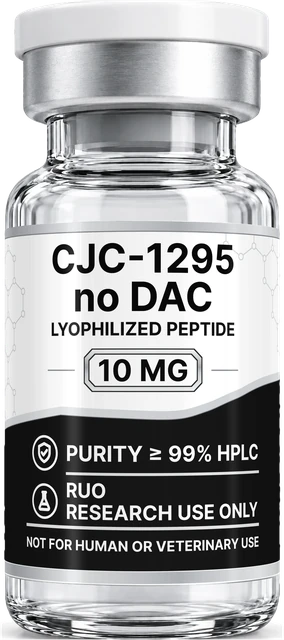
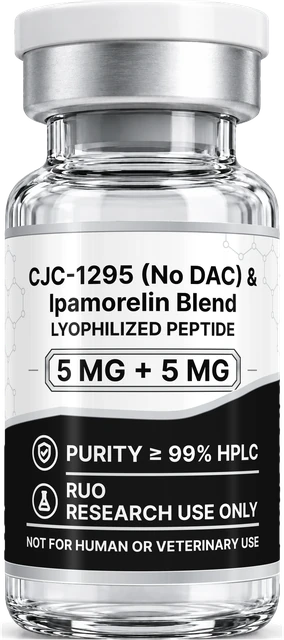
CJC-1295 without DAC is a peptide widely studied in experiments on growth hormone, as well as in research of endocrine signalling processes and models employing growth hormone-releasing hormone axis. It is sometimes referred to as Modified GRF (1-29) or Mod GRF 1-29 and is aimed at mimicking the activity of the truncated growth hormone-releasing hormone fragment with higher stability.
CJC-1295 without DAC 10mg comes in a lyophilized form and is used as a research peptide in controlled lab environments and studies. The focus of research interest lies in the interaction of the compound with growth hormone-releasing hormone receptor, pulsatile secretion of growth hormone, pituitary signaling and insulin-like growth factor 1 axis.
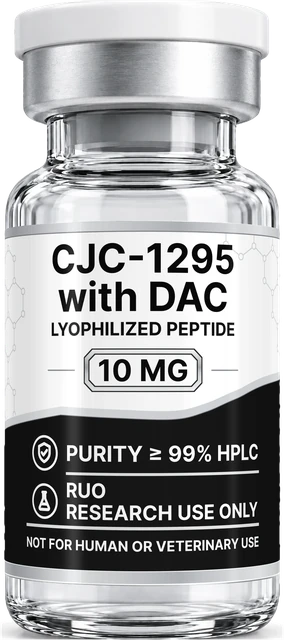
It is important for researchers to differentiate between CJC-1295 without DAC and CJC-1295 with DAC due to their significantly different pharmacokinetics.
What Is CJC-1295 No DAC?
CJC-1295 without DAC is an analog derived from Growth Hormone Releasing Hormone and commonly known as GHRH.
The compound is synthesized by modifying the first 29 amino acids of the natural GHRH hormone, a segment believed to be responsible for the activity at the GHRH receptor site. The modifications are made to make the molecule more stable and resistant to quick degradation due to the activity of enzymes. Thus, CJC-1295 without DAC is useful in research dedicated to peptide stability and endocrine signaling.
“Without DAC” means that the molecule does not contain Drug Affinity Complex which makes its action duration shorter compared to the long-lasting CJC-1295 DAC form. Therefore, this version is especially valuable for researching the issues of transient receptor activation and pulsatility patterns.
Common subjects of research using CJC-1295 without DAC include:
- GHRH receptor activation;
- Signaling pathways of pituitary gland;
- Dynamics of GH pulse secretion;
- Somatotropic axis regulation;
- GH and IGF-1 signaling;
- Peptide stability and degradation;
- Endocrine responses mediated by receptors;
- Peptide combinations research models.
The compound is a laboratory research substance and should be studied in accordance with the limitations of available information.
Why Is CJC-1295 No DAC Being Studied?
The main reason CJC-1295 without DAC is investigated is due to the fact that it has an effect on the GHRH-GH-IGF-1 axis.
Growth hormone releasing hormone is synthesized in the hypothalamus and acts in signalling towards the anterior pituitary gland. In reaction to GHRH receptor activation, somatotroph cells of the pituitary gland are able to release growth hormone in pulses.
Studies of synthetic GHRH analogues are conducted for a better understanding of receptor activation, hormone pulsing and signaling effects.
Areas of research include the following:
Pulsatile growth hormone signalling: The shorter-acting nature of CJC-1295 no DAC makes it relevant to studies investigating temporary receptor activation rather than prolonged stimulation.
Pituitary response models: Researchers can examine signalling mechanisms associated with GHRH receptor activation in controlled experimental conditions.
GH and IGF-1 pathway research: Growth hormone signalling is closely connected with insulin-like growth factor 1 and broader metabolic and cellular pathways.
Peptide combination research: CJC-1295 no DAC is sometimes studied alongside growth hormone secretagogue compounds to examine interactions between separate signalling pathways.
Research into these areas does not establish approved therapeutic applications or guarantee particular biological outcomes.
How Does CJC-1295 No DAC Work?
CJC-1295 no DAC is explored as a growth hormone-releasing hormone analog. The suggested mode of action involves binding to the growth hormone-releasing hormone receptor (GHRHR).
GHRHR represents a member of G-protein coupled receptors which is predominantly expressed in the somatotroph cells of the pituitary gland. Activation of the receptor has been found to affect the intracellular signalling pathways which in turn might impact growth hormone production and secretion.
Using simple language, the following mechanism of action is studied:
Analogue effect to GHRHR activity to pituitary reaction to growth hormone production and secretion to IGF-1 signalling and others downstream.
Lack of DAC is an integral component of this compound’s research profile. CJC-1295 with DAC has been designed for increased activity through the albumin binding, while the no-DAC version has a comparatively short duration of action.
This difference makes CJC-1295 no DAC peptide research especially interesting for experiments with the pulse-driven endocrine signalling.
Understanding CJC-1295 No DAC Dosage
CJC-1295 no DAC dosage information should be analyzed with caution. CJC-1295 no DAC is an experimental drug, and there is no universal dosing schedule used for its application.
For scientific studies, experimental dosing and concentration is determined by the following factors:
- animal type
- use of in vitro/in vivo testing
- experimental endpoint
- sensitivity of the test method used
- length of experiment
- purity of the compound used
- dosage mode
- the study protocol
Scientifically tested quantities and concentration should be used in accordance with research protocol and scientific methodology.
10mg CJC-1295 no DAC vial is the total quantity of peptides in this vial. This number does not represent dosage or treatment regimen of CJC-1295.
It may cause misunderstanding that CJC-1295 with DAC and CJC-1295 no DAC have the same names but different pharmacokinetics. Information about one form cannot be directly applied to the other.
CJC-1295 No DAC and Research Quality
The quality of research becomes vital especially when dealing with synthetic peptides since it can depend on several aspects such as analytical purity, molecular identity, batch consistence and proper storage.
In case of CJC-1295 no DAC evaluation for use in laboratory research one should pay attention to the availability of proper analytical documentation. Standard methods for peptide analysis include HPLC and MS ( mass spectrometry ).
While HPLC can give information about the purity of the sample and possible presence of impurities, MS can help to confirm the identity of the molecule according to its molecular mass.
Proper research documentation should include:
- synthetic compound name, sequence information,
- batch or lot information,
- sample quantity,
- analytical purity information,
- identity testing results,
- Certificate of Analysis availability ,
- stored and handling conditions,
- traceable product documentation.
However, purity percentage alone is not sufficient.
CJC-1295 No DAC in Australia
Research interest in CJC-1295 no DAC Australia is associated with the overall scientific interest in peptide signaling, endocrinology and metabolism studies.
Australian laboratories performing evaluation of research peptides need to take into consideration the regulatory situation of that particular substance and the situation regarding its research use.
CJC-1295 no DAC cannot be advertised as an accepted treatment simply because it is a research grade substance. Researchers should differentiate between preclinical study, research evidence and practical use of the peptide.
For research purposes, clear specifications, batch identification and analytical reports may assist laboratories with material selection prior to the start of experiments.
What to Consider Before You Buy CJC-1295 No DAC
Prior to procuring CJC-1295 no DAC for research purposes, some aspects other than pricing and quantity of the substance should be considered by laboratories. The identity of the substance, batch number, analytical documents, and product specifications among others, should be among the aspects that laboratories take into account when considering whether or not the product is CJC-1295 no DAC and not DAC.
Some of the aspects that one should put into consideration when choosing a research supplier include:
- Whether the product form has been specified
- Batch/Lot details
- Analytical documents
- Vial quantity information
- Proper packaging and storage information
- Research use position
- Supplier documentation process
This would be more of quality procurement than marketing based.
Safety and Current Research
CJC-1295 without DAC is still an investigational drug. No studies published so far provide justification for considering this substance as an effective therapy for body building, anti-aging, muscle gain, fat loss or any other health applications among consumers.
The GH/IGF-1 axis is a very complex system. Modifications of GH and IGF-1 signaling have potential to influence various physiological pathways, but experimental data cannot serve as evidence of safety and efficacy in humans.
Research related to CJC-1295 without DAC needs to follow proper scientific, ethical and regulatory standards. It is necessary to perform appropriate experiments and document proper experimental methods and handling practices.
Further research is required to elucidate pharmacology and biological activity of CJC-1295 without DAC.