 AU
AU
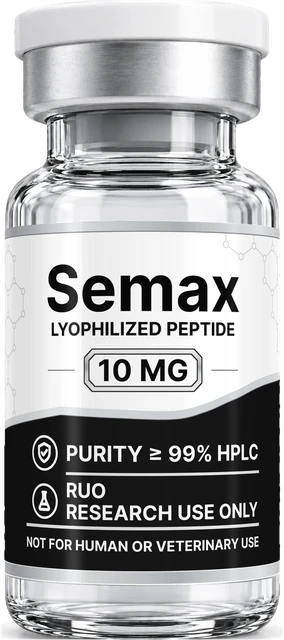
Semax is a lab-produced peptide that receives the most research attention in the fields of neuroscience, neurobiology and cognition. The scientific interest in Semax peptide revolves around the potential effects of the peptide on the neurotrophic signaling, gene expression, neuronal signaling and biological reactions to stress in the nervous system.
The Semax 10mg research formulation offers researchers a concentrated lyophilized form of the peptide for study purposes. When researching Semax, scientists usually pay attention to mechanisms related to brain-derived neurotrophic factor (BDNF), neuroplasticity, neurotransmission and cerebral ischemia.
Due to the growing interest to research peptides in Australia, Semax is gaining popularity as an object of research in neuropeptide studies. Yet, all the existing evidence consists mostly of preclinical trials, and results of the studies in laboratory conditions do not guarantee therapeutic benefits for humans.
What Is Semax?
Semax is a heptapeptide analogue created from a fragment of the adrenocorticotropic hormone (ACTH). It typically consists of the following amino acids: Met-Glu-His-Phe-Pro-Gly-Pro, which is denoted as MEHFPGP.
Structurally, Semax is made up of the ACTH (4-7) fragment joined with the tripeptide Pro-Gly-Pro (PGP). The latter was introduced to enhance the stability of the molecule by increasing its resistance to enzymatic destruction. Scientific literature refers to Semax as to a peptide analogue of ACTH that is studied for its potential to act as a neuroprotector and neurotropic agent.
Unlike the whole ACTH hormone, the study of Semax does not involve the investigation of its endocrine effects, but concentrates on its role in neurological signaling.
Searching for keywords such as Semax peptide, Semax 10mg, Semax Australia, and Semax peptide research reveals increasing interest to the application of this compound in the scientific experiments.
Why Is Semax Being Studied?
Semax is currently being studied due to its activity along a number of neurological pathways. Research studies have been conducted on the peptide regarding such areas as cerebral ischemia, oxidative stress, neurotrophic activity, inflammation, and learning & memory processes.
The key area of research related to Semax is its effects on BDNF signalling. Preclinical studies have been done to see if Semax can affect BDNF protein expression and BDNF/TrkB signalling pathway – pathways that are involved in neuroprotection, neuroadaptation and synapse plasticity.
Other areas of research related to Semax include:
- neuropeptide signalling and gene expression;
- neuronal survival in stressful conditions;
- cerebral ischemia and reperfusion model studies;
- neuroinflammation pathway studies;
- oxidative stress and nitric oxide signalling;
- learning, memory and cognitive process models;
- interactions with neurotransmitter systems.
The above areas of research show why Semax is often referred to in nootropic peptide and neuroprotective peptide research. However, these areas do not prove that Semax helps to improve memory, concentration and neurological health in the general population.
How Does Semax Work?
The exact mechanism of action of Semax has not been fully understood yet. Existing data indicate that the biological effects of Semax can be associated with a number of interconnected molecular pathways rather than with one specific receptor mechanism.
Various laboratory experiments have looked into the changes in gene expression due to the influence of Semax. For example, using RNA sequencing techniques, a difference in the expression of hundreds of genes was found when comparing Semax-administered rats with normal control rats in a model of brain ischaemia/reperfusion.
Another field where Semax studies were conducted is the BDNF pathway. BDNF is a neurotrophic protein responsible for the maintenance and adaptation of neurons. Some experimental results show that Semax can affect various components of the BDNF/TrkB pathway; however, the significance of such results will depend on the experimental setup.
Various proteomic and transcriptomic analyses are still being done to understand how Semax influences molecular reactions under conditions of neurological stress.
Understanding Semax Dosage
The concept Semax dose must be explained correctly. A 10 mg vial represents the amount of substance in the vial; it does not determine the optimal dose for a person.
Experimental protocols may vary greatly depending on the experiment design, dosing regimen, goal of the research, concentration, time of exposure, and endpoint of the experiment. Cell culture concentration cannot be calculated as animal dose, and animal research protocol cannot be translated into the protocol for a person.
For laboratory studies using Semax 10 mg, researchers need to create experimental protocols based on published approaches and methods, laboratory needs, and experiment calculations.
Semax and Research Quality
The issue of quality becomes particularly relevant to peptide study since wrong identity, poor purity, contamination, and degradation may influence experiment outcomes.
In terms of evaluating Semax peptide as a tool for laboratory research, scientists need to pay attention to whether adequate analytical data is provided. Such methods as HPLC and mass spectrometry are used for determining purity and molecular identity accordingly.
In terms of research quality, batch history, storage details, labeling of vials and the link between a Certificate of Analysis and the specific batch become relevant. Purity percentage is insufficient for assessing sterility, identity, stability, and suitability for experiments.
Proper documentation will assist laboratories in the proper evaluation of Semax 10mg research peptide.
Semax in Australia
For individuals looking for Semax Australia, Semax peptide Australia or Semax 10mg Australia, it is important to differentiate research items from therapeutic goods which have been approved.
The Therapeutic Goods Administration (TGA) clarifies that unapproved peptide medicines that are not listed in the Australian Register of Therapeutic Goods have not been evaluated by the regulator for safety, quality or efficacy. In addition, the TGA has made efforts to increase its compliance efforts regarding the illegal importation, advertisement and sale of unapproved peptides.
Depending on the product type, purpose, claims, import conditions and supply arrangements, there may be certain regulatory requirements. Australian consumers and research establishments should check their own regulatory requirements relevant to their circumstances rather than assuming that availability of the product on the internet means regulatory approval.
What to Consider Before You Buy Semax
Prior to purchasing Semax 10mg for any legitimate research purpose, there are other factors to look at besides price and claims of high purity. Some of these factors are transparency of the supplier, identification of batches, analytical testing performed, package quality, and storage details.
Researchers need to check if the certificate of analysis provided is for the specific batch being offered. Analytical methods used are also a factor.
One must take extra caution in dealing with poorly labeled products/materials or materials not properly labeled with enough information. This is the very warning issued by the TGA in regard to imported peptide products being found in unlabeled/unidentified vials.
In Australia, laboratories need to consider these factors along with regulatory requirements.
Safety and Current Research
Research into Semax continues, but not all studies are of equal quality. Mechanistic research uses mainly cell cultures and animal models, including experiments on experimental cerebral ischaemia.
This kind of research is informative regarding potential biological mechanism, but it does not constitute proof of safety or efficacy in a clinical setting. The current research focuses on the gene expression and protein synthesis induced by Semax as well as neurotrophin pathways and other molecular effects of Semax.
Materials used in research of Semax need to be processed in accordance with laboratory guidelines and relevant Australian legislation.