 AU
AU
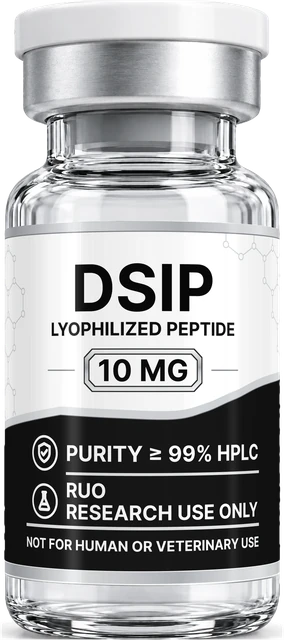
The Delta Sleep-Inducing Peptide, abbreviated to DSIP, is a synthetic research peptide used to determine any possible association with processes relating to the regulation of sleep, circadian rhythms, neuro-endocrine signaling and stress response. Since being discovered in the 1970s, this peptide has been the focus of research interest due to its possible associations with various physiological regulatory systems.
This DSIP 10 mg research substance contains lyophilized peptide material to be used for controlled experimentation. Present DSIP research includes experimental studies relating to sleep structure, neuronal signaling, endocrine regulation, stress adaptation and biological rhythms.
Even though this peptide is commonly associated with sleep research, the biological actions of Delta Sleep-Inducing Peptide seem to be rather complicated. Further research is ongoing to determine whether the results obtained from the use of this substance are direct, indirect or are associated with other signaling processes.
What Is DSIP?
DSIP is an acronym for Delta Sleep-Inducing Peptide, which is a natural peptide discovered during experiments on biological activity related to sleep. DSIP is a peptide that has only nine amino acids. It is referred to as a nonapeptide.
DSIP sequence of amino acids is as follows:
Trp-Ala-Gly-Gly-Asp-Ala-Ser-Gly-Glu
DSIP differs from other peptides in that unlike many peptides, there is no clear receptor pathway for which it functions. Therefore, the biological mechanism of action of DSIP is yet to be fully known. Various experiments have been conducted to test whether DSIP is involved in the regulation of sleep, circadian rhythms, response to stress, neuroendocrine and neurotransmitter activities.
The use of DSIP peptide is mainly confined to the laboratory setting. The preparation of DSIP 10mg is done in order to conduct experiments.
Why Is DSIP Being Studied?
The first scientific interest in DSIP was aroused by experiments linking the peptide to sleep physiology. However, later research was extended to other fields of neuroscience and neuroendocrinology.
Among them are:
- Sleep structure and sleep stage control
- Delta waves and slow-wave sleep
- Circadian rhythms and biological timing
- Stress responses
- Hypothalamic and pituitary signaling
- Neurotransmitter pathways
- Endocrine regulation
- Pain responses
- Oxidative stress and cell protection studies
One of the reasons for DSIP being scientifically interesting is the lack of consistency of experimental data obtained. Variations in models, experimental conditions, delivery modes and study design have led to variable results.
It explains why DSIP is still a topic of mechanism studies rather than a proven therapeutic agent. More controlled studies are required to reveal its physiological function and to find out how physiological systems influence the effects observed experimentally.
How Does DSIP Work?
However, the exact mode of action of the Delta Sleep-Inducing Peptide has not yet been elucidated. Whereas other drugs function mainly via the interaction of one specific receptor, the effects of DSIP may be rather complex and indirect in nature. Various modes of action of DSIP have been proposed by scientists.
Sleep and Circadian Signalling
In terms of sleep-wake physiology, DSIP has been investigated in relation to delta-wave regulation and regulation of circadian rhythms. A certain amount of laboratory research on the effect of DSIP has been carried out in relation to its possible role in slow wave sleep regulation.
Nevertheless, DSIP must not be regarded as a traditional sleeping substance. Its function can be connected with regulating systems, but not with sleep induction.
Neuroendocrine Regulation
DSIP has been studied for its possible connection with the hypothalamic-pituitary axis. This is involved in hormone signaling, stress adaptation, and biological homeostasis.
Experiments have also evaluated possible interactions with corticotropin-dependent signaling pathways and other endocrine signaling processes. The importance of such interactions continues to be researched.
Neurotransmitter Systems
Studies related to DSIP peptides have investigated the possible associations with neurotransmitter functions like serotonergic, dopaminergic, and GABA-related signaling. These signaling systems are engaged in many biological activities like the sleep-wake cycle, neuronal excitability, stress response, and behavioral models. It is under investigation whether DSIP affects these systems directly or has indirect effects on them.
.
Understanding DSIP Dosage
Any information regarding the dosage of DSIP available on the internet could be misleading since the amounts of the chemical used in experiments cannot be taken as standard instructions for humans.
The amount of DSIP that will be utilized in scientific research will depend on several factors such as:
- Type of experiment
- Research purpose
- Requirements for concentration
- Medium through which the DSIP is administered in the experiment
- Time required to observe the effect of the chemical
- Laboratory method
- Procedures for sample preparation and stability
A DSIP 10mg vial refers to the total amount of peptides found in the research vial. It does not indicate the dosage to be used or administration process.
Scientists should come up with research protocols following scientific literature and methodologies. DSIP is still a research chemical and no standardized dosage of DSIP for therapy has been developed.
DSIP and Research Quality
Quality of research material is especially significant for the study of peptides since experiment quality is linked to its properties.
In order to assess DSIP peptide quality for research purposes, a lab may take into account several aspects.
Peptide identity: Analytical methods may assist in checking the conformity of the material to the expected molecular structure of DSIP peptide.
Material purity: Methods such as HPLC may be utilized to assess the material purity and impurities.
Molecular characterization: Mass spectrometry may be helpful in confirming molecular weight and molecular identity.
Batch identification: Identification of batch/lot number will help associate material used for research with appropriate analytical documentation.
Material storage: Peptides may be susceptible to environment conditions such as temperature and light. Proper storage procedures will ensure material integrity.
The quality of DSIP research depends on both material quality and appropriate experimental design.
DSIP in Australia
Interest in the study of DSIP peptides in Australia belongs to the general trend of expansion in the fields of peptide studies, neuroscience and biochemical studies.
In case of Australian scientists studying DSIP, there needs to be a differentiation between research materials of DSIP peptide and products that are being promoted as therapeutic or clinical. Depending on the presentation and use of a substance, its regulatory status and allowed use can vary.
There are certain criteria that research institutions need to consider when deciding on using DSIP 10mg as their research material in Australia.
The reliable supplier of DSIP 10mg research material will be able to provide precise data regarding the substance without claiming experimental results as clinical effects.
What to Consider Before You Buy DSIP
Where one is considering buying DSIP peptide from different suppliers for lab research, it is important to avoid focusing exclusively on price considerations but also look at if the company gives adequate information in order to evaluate and trace the material.
Considerations before purchasing DSIP peptide include:
- The identification of the peptide and amount in the vials
- Batch/lot number
- The certificate of analysis information provided
- Information on the analytical testing of the material
- Packing and handling instructions
- Information on storage
- Research use statement
- Supplier information
Search phrases that would be used in researching the available materials include DSIP peptide Australia, DSIP 10mg, Delta Sleep-Inducing Peptide and DSIP research peptide. However, researchers should evaluate documentation and specifications instead of just focusing on marketing.
Safety and Current Research
DSIP is still an experimental peptide lacking comprehensive evidence. Despite extensive studies conducted in various areas of biological science, results cannot prove that DSIP is an approved medication to treat insomnia, sleep disorder, stress, or any other disease.
Research results have also varied depending on different experimental models. Thus, any information about the effectiveness of DSIP, recommended dosage, and potential physiological effects should be approached cautiously.
Present research topics related to DSIP include studies of sleep architecture, delta wave function, circadian rhythms, neuroendocrine signals, stress pathways, and interactions with neurotransmitters.
DSIP 10mg research substance should be used strictly in scientific and laboratory settings.